Asian Defense News: DTN News - SPECIAL REPORT ON SPORTS: Shon Wan Ho of Korea Took Men's Single Badminton Championships Title At Yonex-Sunrise India Open 2012
(NSI News Source Info) TORONTO, Canada - April 29, 2012: Korea’s Shon Wan Ho won his first ever international title in style this week in New Delhi, making it a Superseries, with a victory over world #1 Lee Chong Wei to boot.

Shon Wan Ho of Korea (R) hugs his coach after defeating Malaysian badminton player Lee Chong Wei during their Men's Singles Final match of the Yonex-Sunrise India Open 2012 at the Siri Fort Sports Complex in New Delhi on April 29, 2012. Ho won 21-18, 14-21, 21-19.
BWF promote the sport of Badminton through an extensive and truly worldwide programme of events. These events have various purposes according to their level and territory in which they are held but those events owned by BWF seek to showcase the Sport via the widest possible quality television broadcast and build the fanbase of the Sport throughout the World.
The world badminton tournament structure has four levels. The Thomas Cup & Uber Cup and Sudirman Cup are Teams Events. The others – Superseries, Grand Prix Events, International Challenge and International Series are all individual tournaments. The higher the level of tournament the larger the prize money and the better the ranking points available.
In addition BWF have responsibility for the International Calendar of Tournaments and Member Associations apply for BWF sanction for their tournaments in return for obligations such as complying with the Laws of Badminton and General Competition Regulations provides the Member Association with a date for their event and inclusion, if appropriate, in the World Ranking system.
Member Associations must apply to sanction a tournament at any of the above levels. The
BWF Tournament Sanctioning Policy applies to the sanctioning of tournaments. Sanction forms for Level 2, 3 and 4
Besides these, the Events Committee also appoints the various technical officials for the BWF events, Super Series and Grand Prix (including Grand Prix Gold) competitions.
(Photo - Getty)
*Link for This article compiled by Roger Smith from reliable sources BWF
*Speaking Image - Creation of DTN News ~ Defense Technology News
*This article is being posted from Toronto, Canada By DTN News ~ Defense-Technology News Contact:dtnnews@ymail.com
©COPYRIGHT (C) DTN NEWS DEFENSE-TECHNOLOGY NEWS
Asian Defense News: DTN News - MALABAR 2012: Delhi Scales Down US War Games - Air force Request To Join Exercise With American Navy Turned Down
 Source: DTN News - - This article compiled by Roger Smith from reliable sources Sujan Dutta - The Telegraph Calcutta
(NSI News Source Info) TORONTO, Canada - April 29, 2012: The Centre recently turned down an air force request to participate in the war games with the US navy in the Bay of Bengal that concluded last week.
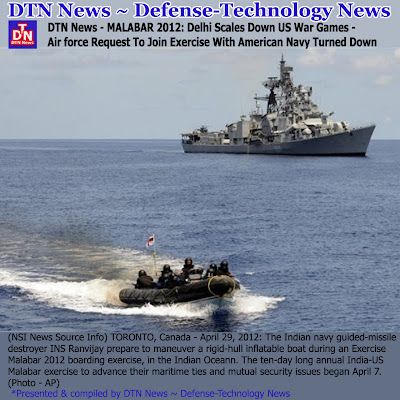
The seven-day Malabar 2012 exercise involved the American and Indian navies.
The Centre’s move followed a quiet policy decision in the defence ministry to scale down — but not stop — the friendly military engagements with the US armed forces, which have gathered pace and increased in complexity over the past decade.
The defence ministry is wary of the “hype” that the US builds around joint military exercises with India.
Among the most important of the war games that the Indian and US forces conduct is the Malabar series involving the two navies. An air force component is integral to the exercises because the US deploys a carrier battle group.
The Malabar exercise in 2007 in the Bay of Bengal involved the armed forces of five countries and was easily the largest international war games that India has hosted. The exercise involved three aircraft carriers and the Indian Air Force (IAF).
That drill irritated the Chinese so much that Beijing asked New Delhi if it was forging a military alliance against it.
For this year’s Malabar exercise, based out of Chennai, the US deployed the Carrier Strike Group-1 with the Nimitz-class carrier USS Carl Vinson in the lead. The US also deployed a Los Angeles-class nuclear submarine.
When the IAF asked to be part of the exercise, the ministry turned down the request. While it was reworking its proposal, air headquarters communicated its desire to naval headquarters.
The navy was of the view that involving the air force would require a change in the “Con Ops” (concept of operations).
The air force wanted to deploy its Shamsher (Jaguar) fighter-bombers that are assigned to the maritime strike role. The IAF’s Maritime Air Operations are headquartered in its southern command.
After the navy told the IAF that it was too late to change the “Con Ops”, the air force wanted a separate exercise with the US navy, the second-largest air force in the world. The USS Carl Vinson alone carries 85 aircraft in its hangars and flight deck.
The highlight of the seven-day Malabar 2012 in the absence of complex maritime-aerial drills was the refuelling in high sea of the USS Carl Vinson by the Indian Navy’s new Italy-built feeder vessel, the INS Shakti. India also deployed the INS Satpura, the indigenously built stealth frigate commissioned earlier this year.
The Carrier Strike Group-1 included, apart from the Nimitz-class aircraft carrier USS Carl Vinson, the Ticonderoga-class guided-missile cruiser USS Bunker Hill and the Arleigh Burke-class guided-missile destroyer USS Halsey (DDG 97).
It also deployed the Military Sealift Command fast combat support ship, the USNS Bridge. The Indian assets included the frigate INS Satpura, destroyers INS Ranvir and INS Ranvijay (D55), and the corvette INS Kulish along with the replenishment oiler INS Shakti.
The exercise took place in approximately 450 nautical miles of sea and air space. The INS Satpura led one group and the USS Bunker Hill another.
*Link for This article compiled by Roger Smith from reliable sources Sujan Dutta - The Telegraph Calcutta
*Speaking Image - Creation of DTN News ~ Defense Technology News
*This article is being posted from Toronto, Canada By DTN News ~ Defense-Technology News Contact:dtnnews@ymail.com
©COPYRIGHT (C) DTN NEWS DEFENSE-TECHNOLOGY NEWS
Asian Defense News: DTN News - TAIWAN DEFENSE NEWS: US Raises Hope Of Sale Of New F-16 Fighter Jets To Taiwan
*Taiwan Weighed for U.S. Jet Sale at Risk of Riling China
Source: DTN News - - This article compiled by Roger Smith from reliable sources Bloomberg Businessweek
(NSI News Source Info) TORONTO, Canada - April 28, 2012: The Obama administration will give “serious consideration” to selling Taiwan new Lockheed Martin Corp. (LMT) (LMT) F-16 fighter jets, a White House official said, creating a potential new flashpoint with China ahead of next week’s high- level meetings between U.S. and Chinese officials.

A jet sale “warrants serious consideration given the growing military threat to Taiwan,” Robert Nabors, the White House’s director of legislative affairs, said in a letter yesterday to Senator John Cornyn, a Texas Republican.
The comments risk spawning a political clash with China as Secretary of State Hillary Clinton and Treasury Secretary Timothy Geithner prepare to meet their Chinese counterparts in Beijing next week for annual talks. China, which insists that Taiwan be reunited with the mainland by force if necessary, has cut military contacts with the U.S. in the past over American arms sales to the island.
“This is going to cause huge problems for the Chinese,” Bonnie Glaser, an analyst at the Center for Strategic and International Studies in Washington, said in an interview. The tension may be compounded if a human-rights group’s speculation bears out that an activist who escaped house arrest in eastern China this week is holed up at the U.S. Embassy in Beijing, she said.
New F-16 C/D fighters would replace aging F-5 jets and supplement a refurbishment program for Taiwan’s F-16 A/Bs that President Barack Obama’s administration announced in September.
Lockheed in Texas
Lockheed has said a Taiwanese purchase of new F-16s would help keep open its production line in Fort Worth, Texas, in Cornyn’s state.
“A contract for new F-16s to Taiwan, depending on timing and quantity, could significantly extend the F-16 production line,” Laura Siebert, a spokeswoman for Bethesda, Maryland- based Lockheed, said in an e-mail yesterday.
Lockheed fell 40 cents to $91.30 at the close in New York trading yesterday and has risen 13 percent this year.
“The Chinese position of opposing U.S. arms sales to Taiwan has been consistent, clear and firm,” Geng Shuang, a spokesman for the Chinese Embassy in Washington, said in an e- mail yesterday.
Taiwan has pressed the U.S. for years to allow the purchase of new F-16s, saying it is falling dangerously behind in its ability to counter potential threats from China. The mainland has an arsenal that includes missiles stationed across the Taiwan Strait.
‘Near-Term’ Decision
The Obama administration plans to decide on a “near-term course of action on how to address Taiwan’s fighter gap, including through the sale to Taiwan of an undetermined number of new U.S.-made fighter aircraft,” Nabors wrote.
The U.S.-Taiwan Business Council, a trade-promotion group that has lobbied for the F-16 sales for years, read that as a pledge to provide the planes.
“They are committing to new aircraft as part of their strategy to assist Taiwan in maintaining a credible defense,” Rupert Hammond-Chambers, the council’s president, said in an e- mail. “We had to date not been successful in getting the administration to admit” that the difference in the number of fighter jets on each side of the Strait is significant, he said.
A spokesman for Taiwan’s representative office in Washington said he didn’t know whether his country had been notified of a potential sale.
“We always appreciate U.S. concern and appreciation of Taiwan’s defense needs,” the spokesman, Frank Wang, said in an interview.
Upgrades Instead
The U.S. parried Taiwan’s request for new fighters in September, agreeing only to a $5.3 billion package to upgrade Taiwan’s older F-16s with new radar, smart bombs and laser- guided equipment. It was the first time in several such announcements that China didn’t suspend military talks.
Chinese officials considered their response last year restrained, Glaser said.
“They believed when we made the decision on the upgrades that that was a done deal and that we were not going to consider going forward with sales of new fighters,” she said. “This will, I think, come to them as a major shock.”
Yesterday’s letter from Nabors differs from a Feb. 15 letter to Cornyn from Acting Undersecretary of Defense James Miller in response to the lawmaker’s demand that the administration acknowledge Taiwan’s defense needs, including F-16s. That came after Obama and Defense Secretary Leon Panetta presented a new defense strategy in January that shifted more attention to the Asia-Pacific region.
‘Cannot Match’
Miller cited announcements of more than $12 billion in arms sales to Taiwan in the previous two years and the conclusions of an earlier report to Congress that Taiwan “cannot match the Mainland one-for-one.”
“We believe the F-16 A/B upgrade effectively meets Taiwan’s current needs,” Miller wrote, while saying the Pentagon would “continue to consider Taiwan’s requests.”
White House spokesman Tommy Vietor said U.S. policy hasn’t changed, and he offered a more non-committal variation on Nabors’ comment about a “near-term course of action.” Vietor said the administration would work with Taiwan “on its development of a comprehensive defense strategy and a resourcing plan.”
“We take very seriously our commitment to Taiwan’s defense as outlined in the Taiwan Relations Act,” Vietor said yesterday in an e-mail. “We do not comment on future possible foreign military sales unless formal congressional notification has taken place.”
Cornyn’s Leverage
Cornyn released Nabors’ letter yesterday after lifting a hold the senator had placed on the administration’s nomination of Obama aide Mark Lippert for assistant secretary of defense for Asia, using the nomination as leverage to press for fighter jet sales to Taiwan. Nabors didn’t specify whether, when or how many fighters the administration would consider.
“We are mindful of and share your concerns about Taiwan’s growing shortfall in fighter aircraft,” Nabors wrote to Cornyn. “We recognize that China has 2,300 operational combat aircraft, while our democratic partner Taiwan has only 490.”
The Obama administration has sought to improve military relations with China while calling repeatedly for the Chinese leadership to be more open about technology it’s developing that could threaten U.S. access in the Asia-Pacific region.
China said in March that it plans to increase defense spending 11.2 percent this year. The country’s defense spending is the second highest in the world after the U.S.
To contact the reporter on this story: Viola Gienger in Washington at vgienger@bloomberg.net
To contact the editor responsible for this story: John Walcott at jwalcott9@bloomberg.net
*Link for This article compiled by Roger Smith from reliable sources Bloomberg Businessweek
*Speaking Image - Creation of DTN News ~ Defense Technology News
*This article is being posted from Toronto, Canada By DTN News ~ Defense-Technology News Contact:dtnnews@ymail.com
©COPYRIGHT (C) DTN NEWS DEFENSE-TECHNOLOGY NEWS
Asian Defense News: DTN News - DEFENSE NEWS: U.S., Japan Agree On Okinawa Troop Relocation
Source: DTN News - - This article compiled by Roger Smith from reliable sources By Karen Parrish - American Forces Press Service
(NSI News Source Info) TORONTO, Canada - April 27, 2012: U.S. and Japanese officials announced yesterday the two nations have agreed on a plan to relocate U.S. Marines from Okinawa to Guam.

The joint statement of the U.S.-Japan Security Consultative Committee spells out unit moves, land and facilities on Okinawa the United States will return to the Japanese government, and the costs each government will pay for the relocation.
The joint statement is the latest result of negotiations between the two countries dating to the 2006 Realignment Roadmap and the 2009 Guam International Agreement.
The two nations issued a joint defense posture statement in February that “delinked” the two agreements so parts of the relocation plan could move forward more quickly.
“I am very pleased that, after many years, we have reached this important agreement and plan of action,” Defense Secretary Leon E. Panetta said in a statement yesterday. He praised Japanese Defense Minister Naoki Tanaka for “spearheading discussions” leading to the joint statement.
“We will work closely with our partners in the Japanese Self Defense Force to implement these decisions and to further improve this vital alliance of ours,” the secretary added.
Panetta said he looks forward to strengthening the two nations’ partnership “as, together, we address security challenges in the region.”
During a Pentagon background briefing to reporters yesterday, senior State and Defense Department officials outlined the agreement.
About 9,000 Marines will relocate from Okinawa, with about 5,000 moving to Guam and the rest transferring to other locations in the Pacific such as Hawaii and Australia, the defense official said.
The Marines will be organized in air-ground task forces, which combine command, ground, air and logistics elements that can deploy and operate as a unit.
“This new posture that we've created results in a more operationally effective presence across the region,” the defense official said.
“In the end, we are sustaining the same presence in the Western Pacific that we've intended for some time,” the official added.
About 10,000 Marines will remain on Okinawa when the relocation is complete, the official said.
The agreement also sets Japan’s funding for the move to Guam at $3.1 billion of the overall $8.6 billion estimated cost, the defense official added.
“We're particularly appreciative of this commitment in the context of Japan's fiscal challenges, which we fully recognize,” the official added.
One element of the agreement involves possible development of joint training ranges in Guam and the commonwealth of the Northern Mariana Islands as shared-use facilities for U.S. and Japanese forces, the official said.
The State Department official said the plan will result in a stronger, more sustainable and more flexible alliance.
“This is really a key component of our strategic rebalancing toward the Asia-Pacific region,” the official said. “As you know, one of the key aspects of that is strengthening partnerships with regional allies, and of course Japan is a very important alliance partner.”
The official said the agreement reaffirms both nations’ commitment to relocate Marine Corps Air Station Futenma, now in the center of Okinawa’s Ginowan City, to a more remote area of the island. Until the Futenma relocation happens, both governments will share the cost of maintaining the existing facility, the official added.
The Japanese government will determine the timeline for the Futenma move, the State Department official said, noting the U.S. focus for Okinawa is sustaining an operationally effective Marine Corps presence there.
The defense official said U.S. representatives are “delighted” at the agreement.
“We think it's a significant achievement that demonstrates that the U.S.-Japan alliance is still capable of big things,” the official said.
Biographies:
Leon E. Panetta
*Link for This article compiled by Roger Smith from reliable sources By Karen Parrish - American Forces Press Service
*Speaking Image - Creation of DTN News ~ Defense Technology News
*This article is being posted from Toronto, Canada By DTN News ~ Defense-Technology News Contact:dtnnews@ymail.com
©COPYRIGHT (C) DTN NEWS DEFENSE-TECHNOLOGY NEWS
Asian Defense News: DTN News - DEFENSE NEWS: U.S., Japan Unveil Revised Plan For Okinawa
Source: DTN News - - This article compiled by Roger Smith from reliable sources Reuters
(NSI News Source Info) TORONTO, Canada - April 27, 2012: The United States and Japan announced on Thursday a revised agreement on streamlining the U.S. military presence on Okinawa that will shift 9,000 Marines from the southern Japanese island to Guam and other Asia-Pacific sites.

The new plan, unveiled days before Japanese Prime Minister Yoshihiko Noda meets President Barack Obama in Washington, helps the allies work around the central but still-unresolved dispute over moving the Futenma air base from a crowded part of Okinawa to a new site that has vexed relations for years.
"I am very pleased that, after many years, we have reached this important agreement and plan of action. I applaud the hard work and effort that went into crafting it," U.S. Defence Secretary Leon Panetta said in a statement.
"Japan is not just a close ally, but also a close friend."
Under the agreement, 9,000 U.S. Marines will be relocated. Five thousand will go to Guam and the rest to other sites such as Hawaii and Australia, a joint U.S.-Japanese statement said.
The updated version of a long-delayed 2006 plan was needed to achieve "a U.S. force posture in the Asia-Pacific region that is more geographically distributed, operationally resilient and politically sustainable," the statement said.
Snags over Okinawa had raised questions about the viability of the Obama administration's strategy of shifting U.S. forces from other regions to the Asia-Pacific to deal with nuclear saber-rattling by North Korea, the rapid military buildup of China and territorial disputes in the South China Sea.
Friction over U.S. bases intensified after the 1995 gang rape of a Japanese schoolgirl by U.S. servicemen. The case sparked widespread protests by Okinawans, who had long resented the American presence due to crime, noise and deadly accidents.
There are about 47,000 U.S. troops in Japan under a 1960 bilateral security treaty.
Okinawa, occupied by the United States from 1945-72, accounts for less than 1 percent of Japan's total land but hosts three-quarters of the U.S. military facilities in the country in terms of land area.
"This has been ... bogged down for years, but now we have been able to come up with a new approach de-linking the Futenma relocation from other elements, like moving out Marine forces to Guam and returning some parts of Okinawa," said Ichiro Fujisaki, Japan's ambassador to the United States.
"Things are going to start moving," he told a gathering at a think tank in Washington.
Kurt Campbell, assistant secretary of state for East Asian and Pacific Affairs, said the deal was discussed widely with U.S. lawmakers, who had refused to fund the overhaul on Okinawa until the Futenma deadlock was resolved and the administration fully explained how the move would fit overall U.S. strategy.
"We think it breaks a very long stalemate ... that has plagued our politics, that has clogged both of our systems," said Campbell.
"REBALANCING" TOWARD ASIA-PACIFIC
A senior State Department official said: "This is really a key component of our strategic rebalancing toward the Asia-Pacific region."
The new policy has also entailed closer U.S. military ties with the Philippines, Australia and Singapore.
The agreement includes a $3.1 billion cash commitment from Japan for the move to Guam as well as for developing joint training ranges on Guam and on Tinian and Pagan in the U.S.-controlled Northern Mariana Islands.
The previous agreement on the move to Guam had Japan providing $6.1 billion in support, with $2.8 billion in cash and the rest in financing arrangements. The two sides agreed to limit that to $3.1 billion from Japan because of the smaller footprint the Marines will have in Guam
Campbell acknowledged that more work needed to be done, including finding a replacement for Futenma.
Proposed replacement sites for Futenma on the subtropical island that lies between Japan's main islands and Taiwan have met strong local opposition. At the same time Tokyo was in political disarray, with six prime ministers in six years.
"Does this agreement answer every question? It does not. Is there more programmatic and technical work that is necessary? Yes," said Campbell.
"But at a fundamental level, we think this agreement moves the ball very substantially down the field in a way that no one would have anticipated a few months ago," he said.
Separating the move to Guam from the Futenma issue frees up the allies to work more on cyber security, space, intelligence, surveillance and reconnaissance operations and ballistic missile defence, a senior U.S. Defence Department official said.
Senators Carl Levin, John McCain and Jim Webb - top members of the U.S. Senate Armed Services Committee who had frozen Okinawa funding until their budgetary and strategic questions were answered - said some of their concerns had been addressed.
"We still have many questions about the specific details of this statement and its implications for our force posture in the Asia-Pacific region," they said in a statement, which also vowed to keep working on "a mutually beneficial, militarily effective, and fiscally sustainable agreement" on Okinawa and Guam.
(Additional reporting by David Alexander; Editing by Peter Cooney, Todd Eastham and Paul Tait)
*Link for This article compiled by Roger Smith from reliable sources Reuters
*Speaking Image - Creation of DTN News ~ Defense Technology News
*This article is being posted from Toronto, Canada By DTN News ~ Defense-Technology News Contact:dtnnews@ymail.com
©COPYRIGHT (C) DTN NEWS DEFENSE-TECHNOLOGY NEWS
Asian Defense News: DTN News: U.S. Department of Defense Contracts Dated April 26, 2012
(NSI News Source Info) TORONTO, Canada - April 26, 2012: U.S. Department of Defense, Office of the Assistant Secretary of Defense (Public Affairs) Contracts issued April 26, 2012 are undermentioned;
CONTRACTS
NAVY
Systems Engineering Associates Corp., Middletown, R.I., is being awarded an $11,178,285 cost-plus-fixed-fee contract to provide engineering, technical, and logistic support services in support of submarine imaging, electronic warfare, communication, antenna, and special project programs. This contract will provide a bridge to allow for continuation of support to the Undersea Warfare Electromagnetic Department until the follow-on Seaport-e task order is awarded. Work will be performed in Middletown R.I. (60 percent), and Newport, R.I. (40 percent), and is expected to be completed by July 2012. Contract funds will not expire at the end of the current fiscal year. This contract was not competitively procured. The Naval Undersea Warfare Center Division Newport, Newport, R.I., is the contracting activity (N66604-12-C-0865).
ERAPSCO, Inc., Columbia City, Ind., is being awarded a $10,538,501 firm-fixed-price contract for 2,006 AN/SSQ-101A sonobuoys in support of Navy antisubmarine forces for the mission of detection, classification, and localization of adversary submarines during peacetime and combat operations. Work will be performed in DeLeon Springs, Fla. (53 percent), and Columbia City, Ind. (47 percent), and is expected to be completed in April 2014. Contract funds in the amount of $257,421 will expire at the end of the current fiscal year. This contract was not competitively procured pursuant to FAR 6.302-1. The Naval Air Warfare Center Aircraft Division, Patuxent River, Md., is the contracting activity (N00421-12-C-0047).
P&S Construction, Inc.*, North Chelmsford, Mass., is being awarded $9,527,000 for firm-fixed-price task order 0009 under a previously awarded multiple award construction contract (N40192-10-D-2804) for design and construction of the Conventional Munitions Maintenance Facility at Andersen Air Force Base. The facility will consist of drive-through work bays, office space, bench stock/tool room, a break/training/ready room, administrative space, and supporting functions to include electrical, communications, mechanical, compressor room, and a janitor’s closet. The project also includes site infrastructure improvements and utilities necessary to support the facility. Work will be performed in Yigo, Guam, and is expected to be completed by July 2014. Contract funds will not expire at the end of the current fiscal year. Six proposals were received for this task order. The Naval Facilities Engineering Command, Marianas, Guam, is the contracting activity.
*Small business
*Link for This article compiled by Roger Smith from reliable sources U.S. DoD issued No. 311-12 April 26, 2012
*Speaking Image - Creation of DTN News ~ Defense Technology News
*This article is being posted from Toronto, Canada By DTN News ~ Defense-Technology News Contact:dtnnews@ymail.com
©COPYRIGHT (C) DTN NEWS DEFENSE-TECHNOLOGY NEWS
Asian Defense News: DTN News - INDIA DEFENSE NEWS: Ukraine On Brink Of Missile Deal With India Reports Media
Source: DTN News - - This article compiled by Roger Smith from reliable sources Ria Novosti
(NSI News Source Info) TORONTO, Canada - April 26, 2012: Ukraine is close to signing one of its biggest ever defense deals for air-to-air missiles with India, according to Russian media reports.

Nezavisimaya Gazeta says the deal for R-27 missiles, worth hundreds of thousands of dollars, is in the final stages and is waiting for approval from the Ukrainian leadership.
The Vympel R-27 (AA-10 Alamo) missile is a medium-to-long-range air-to-air missile developed by the Soviet Union. It is similar to U.S. AIM-7 Sparrow.
The missile comes in infrared-homing (R-27T), semi-active-radar-homing (R-27R), and active-radar-homing (R-27AE) versions. It would be fitted to India’s MiG-29 and Su-30 fighter jets.
While the deal has not been confirmed officially, the paper quotes a source close to Ukraine’s national security and defense council, saying both nations are sensitive to Russian concerns over the deal and want to make sure that it would not irritate Moscow.
Tensions between Kiev and Moscow could arise later because if the deal is successful, India may want to buy other weaponry from Ukraine, entering a market dominated by Russia, defense analysts quoted by the paper said.
Some industry experts believe Moscow would not oppose the deal as the Ukrainian company is the only manufacturer of these missiles, although Russian firms supply some components for R-27.
The R-27 was originally designed by Vympel, a Russian missile design bureau, in the 1980s. Vympel is now part of Russia's Tactical Missiles Corporation, which now produces successor weapons to R-27.
Artem, a Ukrainian arms firm involved in R-27 production in Ukraine, could not be reached for comment.
Ukrainian R-27s displayed by the Artem and Arsenal companies at the Moscow air show in 2011 featured what the makers claimed were upgraded seekers. Arsenal said it had developed a new infra-red seeker for the R-27 extending its detection range from 18 km to 30 km.
New Delhi showed interest at the recent DEFEXPO-2012 arms show in Ukrainian anti-tank missiles and new engines for Mi-family helicopters produced by the Ukrainian Motor Sich company, according to Ukrainian officials.
Related News
Multimedia
*Link for This article compiled by Roger Smith from reliable sources Ria Novosti
*Speaking Image - Creation of DTN News ~ Defense Technology News
*This article is being posted from Toronto, Canada By DTN News ~ Defense-Technology News Contact:dtnnews@ymail.com
©COPYRIGHT (C) DTN NEWS DEFENSE-TECHNOLOGY NEWS


 India Tests First Intercontinental Ballistic Missile