Showing posts with label FINANCIAL SUPPORT. Show all posts

Wednesday, June 20, 2012

DTN News - FINANCIAL NEWS: Global Markets Jump After Greek Vote Eases Fears

Asian Defense News: DTN News - FINANCIAL NEWS: Global Markets Jump After Greek Vote Eases Fears
*Global markets jump as Angela Merkel tells election victor Antonis Samaras she is confident Greece will abide by bailout pledges, and world leaders gather in Mexico for the G20.
Source: DTN News - - This article compiled by Roger Smith from reliable sources The Globe & Mail
(NSI News Source Info) TORONTO, Canada - June 20, 2012: Asian stock markets were up sharply Monday after elections in Greece eased fears of global financial turmoil, but analysts warned that the economic crisis shaking the 17 nations that use the euro was far from over. Stock markets rejoiced at the narrow victory by Greek conservatives who favour upholding an austerity program that their recession-mired country entered into in exchange for a financial bailout from international lenders.

Tokyo’s benchmark Nikkei 225 index was up 1.9 per cent at 8,731.57. Hong Kong’s Hang Seng rose 1.6 per cent to 19,548.83. Australia’s S&P/ASX200 added 1.8 per cent to 4,129.20 and South Korea’s Kospi rose 2.1 per cent at 1,897.62.

On Wall Street, Dow Jones industrial average futures were up 62 points on Sunday night, suggesting the market could open higher Monday. The euro rose to $1.2700 (U.S.) from $1.2637 late Friday in New York. The U.S. dollar rose to 79.22 yen from 78.71 yen.

The New Zealand and Australian dollars were also higher. Both currencies typically rise when investors have more appetite for risk. The Australian dollar was trading above $1.01 and the New Zealand dollar was trading above 79 cents.

Masahiro Yamaguchi, a manager at Mizuho Securities Co. in Tokyo, said the perk in Tokyo stocks came from a sense of relief that the worst had been avoided in Greece.

“There’s is a rebound simply because the risks are now reduced,” he said. “There’s a sense that, at least, things are okay for now. The solution is far from basic.”

On Sunday, pro-bailout parties in Greece won enough seats to form a coalition government.

Greece has been dependent on rescue loans to operate since May 2010, after it was shut out of international markets following years of profligate spending and falsifying financial data.

The country is mired in a fifth year of recession, with unemployment spiralling above 22 per cent and tens of thousands of businesses shutting down.

Greece had to agree to austerity measures to get its bailout. Measures included deep spending cuts on everything from health care to education and infrastructure as well as tax hikes and cuts in salaries and pensions. Anger at the measures has sent Greeks into the streets in frequent strikes and protests, some of them violent.

Some analysts said the election results could overstate the willingness of Greeks to embrace austerity.

“Overall, the Greek election result, while welcome, does not imply that the Greek people are embracing the tough reforms tied to the bailout package. It merely meant that fear overruled anger,” analysts at DBS Bank Ltd. in Singapore wrote in a market commentary.

No one is sure how bad a Greek exit from the euro would have been. Greece would almost have certainly defaulted on its debt, triggering losses for European banks that own its government bonds. The outcome of the election, however tenuous, gives Greece a chance to breathe life into its moribund economy.

“It will be tough, but Greece will survive because I think the tourist industry and the agriculture sector will help it recover from its dire straits right now,” said Francis Lun, managing director of Lyncean Holdings in Hong Kong.

Japanese vehicle makers soared on hopes that Europe, a huge export market, would avoid deepening economic turbulence. Mazda Motor Corp. jumped 4 per cent and Yamaha Motor Co. gained 4.5 per cent.

Steelmakers and shipyards also gained ground. South Korea’s top shipbuilder, Hyundai Heavy Industries, rose 3.1 per cent. Japan’s JFE Holdings Inc. added 4 per cent and Kobe Steel rose 3.3 per cent.

Samsonite International SA rebounded 5.8 per cent after it issued a statement saying its luggage is safe, following a Hong Kong Consumer Council report last week that found carcinogens in the handles of some models, which caused its shares to dive 16 per cent.

But stock market operator Hong Kong Exchanges and Clearing Ltd. fell 2.8 per cent as investors worried a $2.2-billion bid announced last week for the London Metal Exchange was too high.

Benchmark oil for July delivery was up 91 cents to $84.94 per barrel in electronic trading on the New York Mercantile Exchange. The contract rose 12 cents to end at $84.03 a barrel in New York on Friday.

  DTN STOCK MARKET


*Link for This article compiled by Roger Smith from reliable sources The Globe & Mail
*Speaking Image - Creation of DTN News ~ Defense Technology News 
*This article is being posted from Toronto, Canada By DTN News ~ Defense-Technology News Contact:dtnnews@ymail.com 
©COPYRIGHT (C) DTN NEWS DEFENSE-TECHNOLOGY NEWS 

Tuesday, March 6, 2012

DTN News - CHINA THE FIRE DRAGON : Assessing China's Strategy ~ By Stratfor

Asian Defense News: DTN News - CHINA THE FIRE DRAGON : Assessing China's Strategy ~ By Stratfor
Source: DTN News - - This article compiled by Roger Smith from reliable sources By George Friedman - Stratfor
(NSI News Source Info) TORONTO, Canada - March 6, 2012: Simply put, China has three core strategic interests.
Paramount among them is the maintenance of domestic security. Historically, when China involves itself in global trade, as it did in the 19th and early 20th century, the coastal region prospers, while the interior of China -- which begins about 100 miles from the coast and runs about 1,000 miles to the west -- languishes. Roughly 80 percent of all Chinese citizens currently have household incomes lower than the average household income in Bolivia. Most of China's poor are located west of the richer coastal region; this disparity of wealth time and again has exposed tensions between the interests of the coast and those of the interior. After a failed rising in Shanghai in 1927, Mao Zedong exploited these tensions by undertaking the Long March into the interior, raising a peasant army and ultimately conquering the coastal region. He shut China off from the international trading system, leaving China more united and equal, but extremely poor.
The current government has sought a more wealth-friendly means of achieving stability: buying popular loyalty with mass employment. Plans for industrial expansion are implemented with little thought to markets or margins; instead, maximum employment is the driving goal. Private savings are harnessed to finance the industrial effort, leaving little domestic capital to purchase the output. China must export accordingly.
China's second strategic concern derives from the first. China's industrial base by design produces more than its domestic economy can consume, so China must export goods to the rest of the world while importing raw materials. The Chinese therefore must do everything possible to ensure international demand for their exports. This includes a range of activities, from investing money in the economies of consumer countries to establishing unfettered access to global sea-lanes.
The third strategic interest is in maintaining control over buffer states. The population of the historic Han Chinese heartland is clustered in the eastern third of the country, where ample precipitation distinguishes it from the much more dry and arid central and western thirds. China's physical security therefore depends on controlling the four non-Han Chinese buffer states that surround it: Manchuria, Inner Mongolia, Xinjiang and Tibet. Securing these regions means China can insulate itself from Russia to the north, any attack from the western steppes, and any attack from India or Southeast Asia.
Controlling the buffer states provides China geographical barriers -- jungles, mountains, steppes and the Siberian wasteland -- that are difficult to surmount and creates a defense in depth that puts any attacker at a grave disadvantage.

Challenged Interests

Today, China faces challenges on all three of these interests. 
The economic downturn in Europe and the United States -- China's two main customers -- has exposed Chinese exports to increased competition and decreased appetite. Meanwhile, China has been unable to appropriately increase domestic demand and guarantee access to global sea-lanes independent of what the U.S. Navy is willing to allow.
Those same economic stresses also challenge China domestically. The wealthier coast depends on trade that is now faltering, and the impoverished interior requires subsidies that are difficult to provide when economic growth is slowing substantially.
In addition, two of China's buffer regions are in flux. Elements within Tibet and Xinjiang adamantly resist Han Chinese occupation. China understands that the loss of these regions could pose severe threats to China's security -- particularly if such losses would draw India north of the Himalayas or create a radical Islamic regime in Xinjiang.
The situation in Tibet is potentially the most troubling. Outright war between India and China -- anything beyond minor skirmishes -- is impossible so long as both are separated by the Himalayas. Neither side could logistically sustain large-scale multi-divisional warfare in that terrain. But China and India could threaten one another if they were to cross the Himalayas and establish a military presence on the either side of the mountain chain. For India, the threat would emerge if Chinese forces entered Pakistan in large numbers. For China, the threat would occur if large numbers of Indian troops entered Tibet.
China therefore constantly postures as if it were going to send large numbers of forces into Pakistan, but in the end, the Pakistanis have no interest in de facto Chinese occupation -- even if the occupation were directed against India. The Chinese likewise are not interested in undertaking security operations in Pakistan. The Indians have little interest in sending forces into Tibet in the event of a Tibetan revolution. For India, an independent Tibet without Chinese forces would be interesting, but a Tibet where the Indians would have to commit significant forces would not be. As much as the Tibetans represent a problem for China, the problem is manageable. Tibetan insurgents might receive some minimal encouragement and support from India, but not to a degree that would threaten Chinese control.
So long as the internal problems in Han China are manageable, so is Chinese domination of the buffer states, albeit with some effort and some damage to China's reputation abroad.
The key for China is maintaining interior stability. If this portion of Han China destabilizes, control of the buffers becomes impossible. Maintaining interior stability requires the transfer of resources, which in turn requires continued robust growth of the Chinese coastal economy to generate the capital to transfer inland. Should exports stop flowing out and raw materials in, incomes in the interior would quickly fall to politically explosive levels. (China today is far from revolution, but social tensions are increasing, and China must use its security apparatus and the People's Liberation Army to control these tensions.)
Maintaining those flows is a considerable challenge. The very model of employment and market share over profitability misallocates scores of resources and breaks the normally self-regulating link between supply and demand. One of the more disruptive results is inflation, which alternatively raises the costs of subsidizing the interior while eroding China's competitiveness with other low-cost global exporters.
For the Chinese, this represents a strategic challenge, a challenge that can only be countered by increasing the profitability on Chinese economic activity. This is nearly impossible for low value-added producers. The solution is to begin manufacturing higher value-added products (fewer shoes, more cars), but this necessitates a different sort of work force, one with years more education and training than the average Chinese coastal inhabitant, much less someone from the interior. It also requires direct competition with the well-established economies of Japan, Germany and the United States. This is the strategic battleground that China must attack if it is to maintain its stability.

A Military Component

Besides the issues with its economic model, China also faces a primarily military problem. China depends on the high seas to survive. The configuration of the South China Sea and the East China Sea render China relatively easy to blockade. The East China Sea is enclosed on a line from Korea to Japan to Taiwan, with a string of islands between Japan and Taiwan. The South China Sea is even more enclosed on a line from Taiwan to the Philippines, and from Indonesia to Singapore. Beijing's single greatest strategic concern is that the United States would impose a blockade on China, not by positioning its 7th Fleet inside the two island barriers but outside them. From there, the United States could compel China to send its naval forces far away from the mainland to force an opening -- and encounter U.S. warships -- and still be able to close off China's exits.
That China does not have a navy capable of challenging the United States compounds the problem. China is still in the process of completing its first aircraft carrier; indeed, its navy is insufficient in size and quality to challenge the United States. But naval hardware is not China's greatest challenge. The United States commissioned its first aircraft carrier in 1922 and has been refining both carrier aviation and battle group tactics ever since. Developing admirals and staffs capable of commanding carrier battle groups takes generations. Since the Chinese have never had a carrier battle group in the first place, they have never had an admiral commanding a carrier battle group.
China understands this problem and has chosen a different strategy to deter a U.S. naval blockade: anti-ship missiles capable of engaging and perhaps penetrating U.S. carrier defensive systems, along with a substantial submarine presence. The United States has no desire to engage the Chinese at all, but were this to change, the Chinese response would be fraught with difficulty.
While China has a robust land-based missile system, a land-based missile system is inherently vulnerable to strikes by cruise missiles, aircraft, unmanned aerial vehicles currently in development and other types of attack. China's ability to fight a sustained battle is limited. Moreover, a missile strategy works only with an effective reconnaissance capability. You can't destroy a ship if you don't know where it is. This in turn necessitates space-based systems able to identify U.S. ships and a tightly integrated fire-control system. That raises the question of whether the United States has an anti-satellite capability. We would assume that it does, and if the United States used it, it would leave China blind.
China is therefore supplementing this strategy by acquiring port access in countries in the Indian Ocean and outside the South China Sea box. Beijing has plans to build ports in Myanmar, which is flirting with ending its international isolation, and Pakistan. Beijing already has financed and developed port access to Gwadar in Pakistan, Colombo and Hambantota in Sri Lanka, Chittagong in Bangladesh, and it has hopes for a deepwater port at Sittwe, Myanmar. In order for this strategy to work, China needs transportation infrastructure linking China to the ports. This means extensive rail and road systems. The difficulty of building this in Myanmar, for example, should not be underestimated.
But more important, China needs to maintain political relationships that will allow it to access the ports. Pakistan and Myanmar, for example, have a degree of instability, and China cannot assume that cooperative governments will always be in place in such countries. In Myanmar's case, recent political openings could result in Naypyidaw's falling out of China's sphere of influence. Building a port and roads and finding that a coup or an election has created an anti-Chinese government is a possibility. Given that this is one of China's fundamental strategic interests, Beijing cannot simply assume that building a port will give it unrestricted access to the port. Add to this that roads and rail lines are easily sabotaged by guerrilla forces or destroyed by air or missile attacks.
In order for the ports on the Indian Ocean to prove useful, Beijing must be confident in its ability to control the political situation in the host country for a long time. That sort of extended control can only be guaranteed by having overwhelming power available to force access to the ports and the transportation system. It is important to bear in mind that since the Communists took power, China has undertaken offensive military operations infrequently -- and to undesirable results. Its invasion of Tibet was successful, but it was met with minimal effective resistance. Its intervention in Korea did achieve a stalemate but at horrendous cost to the Chinese, who endured the losses but became very cautious in the future. In 1979 China attacked Vietnam, but suffered a significant defeat. China has managed to project an image of itself as a competent military force, but in reality it has had little experience in force projection, and that experience has not been pleasant.

Internal Security vs. Power Projection

The reason for this inexperience stems from internal security. The People's Liberation Army (PLA) is primarily configured as a domestic security force -- a necessity because of China's history of internal tensions. It is not a question of whether China is currently experiencing such tensions; it is a question of possibility. Prudent strategic planning requires building forces to deal with worst-case situations. Having been designed for internal security, the PLA is doctrinally and logistically disinclined toward offensive operations. Using a force trained for security as a force for offensive operations leads either to defeat or very painful stalemates. And given the size of China's potential internal issues and the challenge of occupying a country like Myanmar, let alone Pakistan, building a secondary force of sufficient capability might not outstrip China's available manpower but would certainly outstrip its command and logistical capabilities. The PLA was built to control China, not to project power outward, and strategies built around the potential need for power projection are risky at best.
It should be noted that since the 1980s the Chinese have been attempting to transfer internal security responsibilities to the People's Armed Police, the border forces and other internal security forces that have been expanded and trained to deal with social instability. But despite this restructuring, there remain enormous limitations on China's ability to project military power on a scale sufficient to challenge the United States directly.
There is a disjuncture between the perception of China as a regional power and the reality. China can control its interior, but its ability to control its neighbors through military force is limited. Indeed, the fear of a Chinese invasion of Taiwan is unfounded. It cannot mount an amphibious assault at that distance, let alone sustain extended combat logistically. One option China does have is surrogate guerrilla warfare in places like the Philippines or Indonesia. The problem with such warfare is that China needs to open sea-lanes, and guerrillas -- even guerrillas armed with anti-ship missiles or mines -- can at best close them.

Political Solution

China therefore faces a significant strategic problem. China must base its national security strategy on what the United States is capable of doing, not on what Beijing seems to want at the moment. China cannot counter the United States at sea, and its strategy of building ports in the Indian Ocean suffers from the fact that its costs are huge and the political conditions for access uncertain. The demands of creating a force capable of guaranteeing access runs counter to the security requirements inside China itself.
As long as the United States is the world's dominant naval power, China's strategy must be the political neutralization of the United States. But Beijing must make certain that Washington does not feel so pressured that it chooses blockade as an option. Therefore China must present itself as an essential part of U.S. economic life. But the United States does not necessarily see China's economic activity as beneficial, and it is unclear whether China can maintain its unique position with the United States indefinitely. Other, cheaper alternatives are available. China's official rhetoric and hard-line stances -- designed to generate nationalist support inside the country -- might be useful politically, but strain relations with the United States. It doesn't strain relations to the point of risking military conflict, but given China's weakness, any strain is dangerous. The Chinese feel they know how to walk the line between rhetoric and real danger with the United States. It is still a delicate balance.
There is a perception that China is a rising regional and even global power. It may be rising but it is still far from solving its fundamental strategic problems and further yet from challenging the United States. The tensions within China's strategy are certainly debilitating, if not fatal. All of its options have serious weaknesses. China's real strategy must be to avoid having to make risky strategic choices. China has been fortunate for the past 30 years being able to avoid such decisions, but Beijing utterly lacks the tools required to reshape that environment. Considering how much of China's world is in play right now -- Sudanese energy disputes and Myanmar's political experimentation leap to mind -- this is essentially a policy of blind hope.

*Link for This article compiled by Roger Smith from reliable sources By George Friedman - Stratfor
*Speaking Image - Creation of DTN News ~ Defense Technology News 
*This article is being posted from Toronto, Canada By DTN News ~ Defense-Technology News Contact:dtnnews@ymail.com 
©COPYRIGHT (C) DTN NEWS DEFENSE-TECHNOLOGY NEWS 

Monday, December 19, 2011

DTN News - U.S. FINANCIAL CRISIS NEWS: U.S. President Barack Obama Secured Funds For Next Nine Months To Avert Government Shutdown

Asian Defense News: DTN News - U.S. FINANCIAL CRISIS NEWS: U.S. President Barack Obama Secured Funds For Next Nine Months To Avert Government Shutdown
Source: DTN News - - This article compiled by Roger Smith from reliable sources
 (NSI News Source Info) TORONTO, Canada - December 19, 2011: U.S. President Barack Obama walks away from the podium after making a statement in the White House Briefing Room in Washington December 17, 2011. The U.S. Senate on Saturday passed a $915 billion bill to fund most federal agency activities through next September and avert a government shutdown.

As America enters its worst economic period since the Great Depression, it is essential that we develop a broad understanding of the many factors that contributed to the U.S. financial crisis. This topic covers the latest news and information on the U.S. financial crisis, including a deep look into possible causes.  


U.S. Financial Crisis is part of Business Exchange, suggested by Bruce Judson. This topic contains 6,262 news and 463 blog items. Read updated news, blogs, and resources about U.S. Financial Crisis. Find user-submitted articles and reactions on U.S. Financial Crisis from like-minded professionals.

The collapse of Lehman Brothers in September 2008 helped trigger an economic and financial crisis that swept across the globe. 


*Euro-zone bank failures could lead to a credit squeeze in the United States


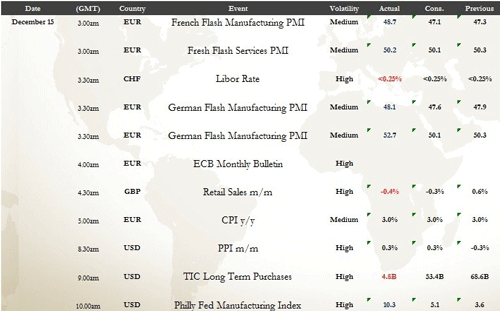
Concerns over the European debt crisis were overshadowed by stronger than expected economic data out of the US. The US Labor Depart-ment released figures that showed that initial jobless claims fell by 19,000 to 366,000 last week to their lowest levels since May 2008. Further-more, two reports from New York and Philadelphia indicated that manufacturing expanded more than forecast while the Federal Reserve Bank of New York's general economic index rose it the highest levels in seven months. The general strength of the data has prevented further falls in the markets overnight. The EUR has recovered to above 1.3000.

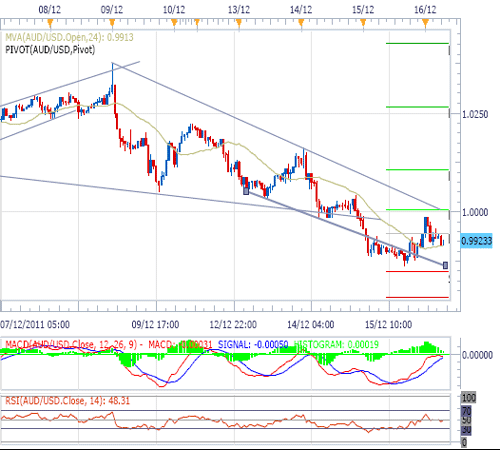
Meanwhile, Christine Lagarde, the MD of the International Monetary Fund made comments that, in the absence of the strong US data, would have triggered another market meltdown. She said that there is no country in the world that will be “immune to the crisis that we see not only unfolding, but escalating at a point where everybody would actually have to focus on what it can do.” Rising protectionism and isolation will lead to a situation similar to “what happened in the 30's and what followed is not something we are looking forward to.” Despite these dra-matic comments, the Australian dollar has recovered to above 0.9900 after having traded as low as 0.9860 during the European session.

Equity markets have stabilised after the release of stronger than expected US data. European bourses rose after Spain successfully sold EUR 6 billion in long term bonds with the DAX gaining 0.98% to 5,730 and the FTSE rose 0.63% to 5,401. In the US, the S&P500 has closed 0.32% higher at 1,215 as financial stocks rallied. Today, we have a data free Asian session so expect subdued conditions.

Commodities continued to ease overnight after the massive rout in the previous overnight session. WTI crude futures have fallen another 1.40% to $93.60 in response to Fed data that indicated falls in industrial output for the first time. Precious metals fell again on the back of a reduction in the probability of additional stimulus by the Fed Reserve. Gold is heading for its first quarterly loss in over 3 years losing 1% to $1,569 while silver gained 0.19% to $28.99. Soft commodities were mixed while copper has lost 0.55%. The CRB index has lost 0.84 points to 294.45.


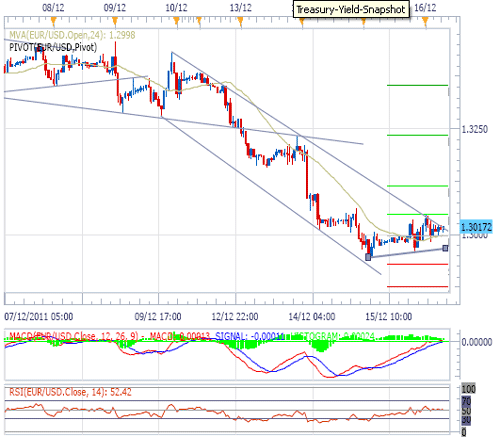
EUR/USD opened the European session just below 1.3000 and once the better than expected Spanish government bond auctions took place the risk sentiment across all mar-kets increased with the Euro rallying towards the middle of the 1.30’s. New offers and profit taking from intraday speculative names capped the topside twice and once the negativity start-ed again thanks to Lagarde and Draghi the price dipped briefly back below 1.3000 before squeezing back to the middle of the range to close the US session at 1.3017.

Well that was a surprise with all the market data being released during both Europe and America, we were expecting a much more volatile two sessions of trade and to see a 70 point range in the Euro is very very disap-pointing! However, the quiet nature is likely to be even tighter than yesterdays 16 point range during Asia! Dips towards 1.2980 should pro-vide a floor whilst offers just above from rang-ers look likely to cap!


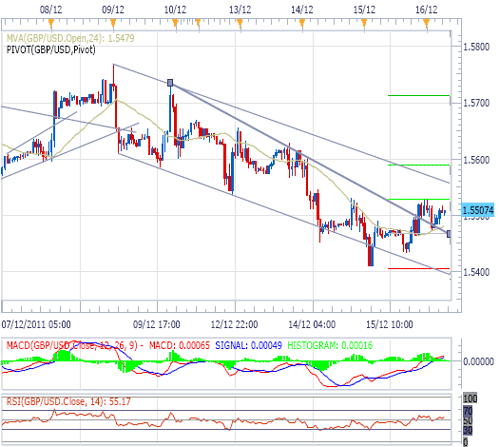
GBP/USD moved higher during the Lon-don morning despite the weaker than expected data releases, as the risk market sentiment increased because of the Spanish Bond auc-tions and some positive Eurozone data! The rally took the Cable above 1.5500 to make a 1.5530 top before the US morning selling re-started as warnings from Lagarde and Draghi about the state of the European Union and possible actions that the ECB could take in the future disappointed. These caused a short dip back to 1.5470 before we now close the day still being higher at 1.5508. Whilst we are not expecting much for the last session of the Asia week, a continued squeeze higher is not out of the question. We could possibly see a bounce towards 1.5570 where we should see new selling and longer term traders turning over some of the positions they squared when the price neared 1.5410. A dip towards 1.5470 should be enough for Asia but a break lower should see us return to 1.5410 soon.


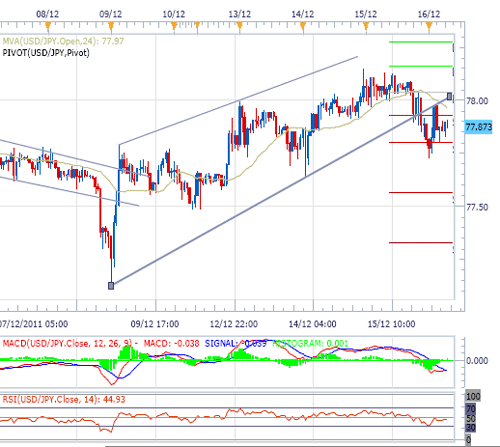
USD/JPY has fallen back below the 78.00 handle during the late European and early US morning as the risk sentiment increased, so did the flow back out of the USD. The positive Spanish Bond auction and some OK Europe-an data lead the risk recovery. USD/JPY fell to a low of 77.75 as the pair just managed to get weak stops right on the 77.80 level. However, the momentum could not continue lower as the major player are still sitting on the sidelines with the USDJ/PY at present because of a cou-ple of factors, one being fear of BoJ interven-tion and the other the flow related to safe ha-ven movements on the large investors and money managers. The lack of data across the Asia region should ensure a slow day for the markets with traders focusing on Christmas shopping and plans for the holiday break. We are expecting today’s range to be 77.70 on the downside and offers at 78.00 even to cap any potential topside moves.


AUD/USD rallied strongly during the Eu-ropean session as the risk tone improved on the back of the Spain Bond auctions doubling the expected investment amount and whilst early US morning data was also better than expected. The AUD price managed to reach 0.9990 before option related selling and new bears took the opportunity to jump on the squeeze. Slow US session trade and the same sort of warnings from Lagarde and Draghi took the shine off the day and we now have the AUD closing at 0.9925.

Data free Friday again for the Australian mar-kets and with a lack of Asia data releases or events today it looks very unlikely that we will see any major movements with the tone dur-ing Asia this week being more focused on the coming holidays than any sign of market vola-tility. We will be looking for continued selling into the high 0.9900’s to cap any topside movement and dips towards 0.9880 should just about do it for today!


Disclaimer:
Fusion Media would like to remind you that the data contained in this website is not necessarily real-time nor accurate. All stock prices, indexes, futures and Forex prices are not provided by exchanges but rather by market makers, and so prices may not be accurate and may differ from the actual market price, meaning prices are indicative and not appropriate for trading purposes. Therefore Fusion Media doesn't bear any responsibility for any trading losses you might incur as a result of using this data .

Fusion Media or anyone involved with Fusion Media will not accept any liability for loss or damage as a result of reliance on the information including data, quotes, charts and buy/sell signals contained within this website. Please be fully informed regarding the risks and costs associated with trading the financial markets, it is one of the riskiest investment forms possible.


*Link for This article compiled by Roger Smith from reliable sources 
*Speaking Image - Creation of DTN News ~ Defense Technology News 
*This article is being posted from Toronto, Canada By DTN News ~ Defense-Technology News Contact:dtnnews@ymail.com 
©COPYRIGHT (C) DTN NEWS DEFENSE-TECHNOLOGY NEWS

Monday, November 28, 2011

DTN News - IRAN NEWS: Enemy Of Iranian State / Iran Threatens To Bomb Turkey If U.S. Or Israel Attacks Its Nuclear Installations

Asian Defense News: DTN News - IRAN NEWS: Enemy Of Iranian State / Iran Threatens To Bomb Turkey If U.S. Or Israel Attacks Its Nuclear Installations
*Telegraph View: The expulsion of Britain’s ambassador to Iran has provided a vivid insight into the mindset of the Islamic regime
DTN Canada Source: DTN News - - This article compiled by Roger Smith from reliable sources Telegraph - UK / Daily Mail - UK
(NSI News Source Info) TORONTO, Canada - November 28, 2011: By urging the expulsion of Britain’s ambassador, Iran’s parliament has provided a vivid insight into the mindset of the Islamic Republic’s leadership. Their first thought as they retreat further into isolation and economic malaise is to credit Britain with prime responsibility for all their problems.

For over a century, British statecraft was indeed the dominant factor in Iranian politics, causing the downfall of leaders who were thought to threaten London’s interests. But the era when a string of Royal Navy bases guaranteed that the Gulf was a British lake ended several generations ago. However, the old men who misrule Iran still claim to detect a British hand behind every significant event.

The latest trigger for their suspicion appears to have been the Treasury’s (overdue) decision to exclude Iran from transactions with the UK financial system. Meanwhile, another round of UN sanctions is approaching as Iran’s efforts to acquire nuclear weapons capability become increasingly obvious.

While the regime may well ignore the parliamentary vote, it clearly believes that Britain will be the guiding force behind this diplomatic drive. When millions marched in Tehran to protest against Mahmoud Ahmadinejad’s victory in the rigged elections of 2009, that too was blamed on the British. Ayatollah Ali Khamenei, the obdurate “Supreme Leader”, claimed on that occasion that Britain was the regime’s “greatest enemy”.

Perhaps we should rejoice in the status that all this accords us. Perception can amount to reality in international affairs, so the fact that Iran vastly overestimates our national power should cause us to be more assertive. And if Tehran’s ossified, brutal leaders regard us as their foremost opponent, that is an honour indeed.

*Iran Threatens To Bomb Turkey If U.S. Or Israel Attacks Its Nuclear Installations

Iran will bomb Turkey if the U.S. or Israel tries to destroy its nuclear installations, a senior military commander warned today.


General Amir Ali Hajizadeh, head of the aerospace division of the powerful Revolutionary Guard, threatened to target Nato's missile defence shield in the neighbouring country.

The system which Turkey only agreed to install in September, is designed to prevent Iranian missile attacks on Israel.

Warning: Iran's Supreme Leader Ayatollah Ali Khamenei, seen meeting veterans in Tehran today, said plans to attack Turkey was part of Iran's strategy of respinding ¿to threats with threats¿

map2.jpg


Preparing: Khamenei, flanked by military and Revolutionary Guards commanders, reviews female members of the Basij militia in Tehran today

Provoking: Masked members of Iran's paramilitary Basij militia parade in front the former U.S embassy


The warning is part of is part of a new strategy devised by the Supreme Leader Ayatollah Ali Khamenei that consists of responding ‘to threats with threats’.


General Hajizadeh said: ‘Should we be threatened, we will target NATO's missile defense shield in Turkey and then hit the next targets.’


Tensions have been rising between Iran and the West since the release of a report earlier this month by the International Atomic Energy Agency.


VOTE TO EXPEL UK AMBASSADOR

Iranian lawmakers today voted to expel Britain's ambassador to Tehran in a new outbreak of hostility towards its old imperial foe.

To a chorus of ‘death to England’ shouts, parliamentarians approved a bill requiring reduced diplomatic relations due to London’s support of upgraded U.S. sanctions.

During an open session broadcast live by state radio, 171 out of 196 MPs present voted for in favour of the measure.

Unlike the U.S., which has had no ambassador in Iran since the 1979 hostage crisis, Britain has maintained full diplomatic relations with the Islamic Republic.

However, Iranians have long been suspicious of the UK in large part due to Britain’s long-held influence on its rulers and economy prior to the Islamic revolution.

Britain's Foreign Office today said the decision to order the country's ambassador, Dominick John Chilcott, to leave Tehran was regrettable.

‘This unwarranted move will do nothing to help the regime address their growing isolation, or international concerns about their nuclear program and human rights record,’a spokesman said.

‘If the Iranian government acts on this, we will respond robustly in consultation with our international partners.’

It said for the first time that Tehran was suspected of conducting secretexperiments whose sole purpose was the development of nuclear arms.


The U.S. and its Western allies suspect Iran of trying to produce atomic weapons, and Israel, which views Tehran as an existential threat, has warned of a possible strike on Iran's nuclear programme.


Iran says its programme is for peaceful purposes.


A military installation in the Turkish town of Kurecik, some 435 miles west of the Iranian border, has been designated as the radar site, according to Turkish government officials.

General Hajizadeh said the United States also plans to install similar stations in Arab states, which has spurred Iran to alter its military defence strategy.


Iran's Supreme Leader Ayatollah Ali Khamenei, who has the final say on all statematters, is also commander in chief of Iran's armed forces.


Another senior Guard commander, Yadollah Javani, threatened that Tehran will target Israel's nuclear facilities should the Jewish state attack Iran.


‘If Israel fires a missile at our nuclear facilities or vital installations, it should know that Israel's nuclear centres will be the target of our missiles,’ the semiofficial ISNA news agency quoted him as saying.


Also Saturday, the chief of Iran's elite Quds Force said he doesn't fear assassination and is ready for ‘martyrdom.’


The comments by Quds Force commander Brigadeer General Ghassem Soleimani were published in several Iranian newspapers.


The Quds Force is the special foreign operations unit of the country's powerful Revolutionary Guard, and Soleimani is a key figure in Iran's military establishment but rarely speaks in public.

Fervour: Young militia members flash victory signs in front of an anti-U.S. mural painted on a wall in Tehran

Ready for war: Soldiers on Tehran's streets has become an increasingly common sight in recent weeks

Menacing: Balaclava-wearing members of the Basij militia were out in force during an anti-U.S. protest on Friday

Debate: Iran's parliament today as it approved a bill to reduce Tehran's diplomatic relations with London and withdraw the country's ambassador to Britain


Tensions have increased in recent weeks between Iran and the U.S., with several American neoconservatives urging the Obama administration to use covert action against Iran and kill some of its top officials, including Soleimani.


The force has been accused by the Americans of involvement in an alleged plot to assassinate the Saudi ambassador to Washington. Two men, including an alleged member of Iran's Quds Force, have been charged in New York federal court in the case.

Iran has dismissed the American claims as a ‘foolish plot’, saying U.S. officials have offered no proof.


Read more: http://www.dailymail.co.uk/news/article-2066959/Iran-threatens-bomb-Turkey-U-S-Israel-attack-nuclear-installations.html#ixzz1ezOmU7pO

Disclaimer statement
Whilst every effort has been made to ensure the accuracy of the information supplied herein, DTN News ~ Defense-Technology News cannot be held responsible for any errors or omissions. Unless otherwise indicated, opinions expressed herein are those of the author of the page and do not necessarily represent the corporate views of DTN News ~ Defense-Technology News

*Link for This article compiled by Roger Smith from reliable sources
*Speaking Image - Creation of DTN News ~ Defense Technology News
*This article is being posted from Toronto, Canada By DTN News ~ Defense-Technology News

©

COPYRIGHT (C) DTN NEWS DEFENSE-TECHNOLOGY NEWS