Showing posts with label SINGAPORE AIRLINES. Show all posts

Monday, January 14, 2013

DTN News - AIRBUS AIRLINES NEWS: Singapore Airlines Firms Up Order For More A380s And A350 XWBs

Asian Defense News: DTN News - AIRBUS AIRLINES NEWS: Singapore Airlines Firms Up Order For More A380s And A350 XWBs
**Repeat order shows great endorsement of Airbus products
Source: DTN News - - This article compiled by Roger Smith from reliable sources Airbus
(NSI News Source Info) TORONTO, Canada - January 14, 2013: Singapore Airlines (SIA) has firmed up an order for 25 more widebody aircraft from Airbus, comprising five of the world’s most efficient, high capacity aircraft, the A380, and 20 A350-900s. The deal was completed in 2012 and follows an agreement in October 2012. 

Singapore Airlines has placed three consecutive orders for the A380, making it the second largest customer of the A380, and now has 19 aircraft in service. In the mid-size category, the new A350 XWB order sees the airline double its backlog for the all-new aircraft to 40. The A350-900s will be used by the airline on both medium and long haul routes.

“This second repeat order from one of the largest A380 operators today is a great endorsement” said John Leahy, Chief Operating Officer, Customers, Airbus. “We’re also delighted that Singapore Airlines are demonstrating equal confidence in the A350. With both these aircraft, Singapore Airlines will have the most modern, most comfortable and most efficient fleet the market can offer.” 

Since 2006 the A380 is registering repeat orders by satisfied customers every year, bringing the total orderbook today to 262 from 20 customers. The A350 XWB gathered 582 orders from 34 customers.

Since first entering service with Singapore Airlines in 2007, the A380 has joined the fleets of nine world class carriers. Typically seating 525 passengers in three classes, the aircraft is capable of flying 8,500 nautical miles or 15,700 kilometres non-stop, carrying more people at lower cost and with less impact on the environment. The spacious, quiet cabin and smooth ride have made the A380 a firm favourite with passengers, resulting in higher load factors wherever it flies. 

The A350 XWB (Xtra Wide-Body) is an all-new mid-size long range product line comprising three versions and seating between 270 and 350 passengers in typical three-class layouts. The new Family will bring a step change in efficiency compared with existing aircraft in this size category, using 25 per cent less fuel and providing an equivalent reduction in CO2 emissions. Entry into service is scheduled for 2014


AIRBUS RELATED NEWS;


THAI SMILE TO BECOME FIRST A320 COMMERCIAL OPERATOR TO USE AIRBUS’ FLIGHT HOUR SERVICES

Securing the highest service level and operations
10 JANUARY 2013 PRESS RELEASE
THAI Smile, a subsidiary of THAI Airways International Public Company Limited will become the first Airbus A320 commercial operator to benefit from Airbus’ Flight Hour Services Tailored Support Package (FHS-TSP) following a contract signed between THAI Airways International and Airbus.
The contract, which will run for 15 years, provides an extensive scope of A320 line replaceable units (LRUs) and spare parts availability, LRUs repairs, logistics services, tools availability, APU and nacelle services. An...

MIDDLE EAST AIRLINES FIRMS UP ORDER FOR TEN A320NEO FAMILY AIRCRAFT

World’s most fuel efficient single aisle aircraft continues to attract new customers
9 JANUARY 2013 PRESS RELEASE
Middle East Airlines-Air Liban (MEA), the flag carrier of Lebanon, has signed a firm contract for ten A320neo Family aircraft (five A321neo and five A320neo aircraft). This follows the signing of a memorandum of understanding which was announced on 12th July 2012. MEA will announce its engine choice at a later date.
“Airbus’ A320neo Family is the ideal choice for an airline such as Middle East Airlines,” said MEA Chairman-Director General, Mohamad El Hout. “An aircraft offering fuel burn saving, high reliability as well as a modern and comfortable cabin is a sound investment in anyone’s...

CIT ADDS TEN A350 XWB AIRCRAFT TO ITS PORTFOLIO

Repeat order from top lessor confirms strong market demand for A350 XWB
3 JANUARY 2013 PRESS RELEASE
CIT Group Inc. (NYSE CIT), a global leader in transportation finance has placed a firm order for 10 A350-900s. This is the second time CIT has ordered A350 XWBs and brings the lessor’s total backlog for the type to 15.
“This order for Airbus A350 XWBs will further expand our portfolio of medium-to-long haul aircraft,” said C. Jeffrey Knittel, President of CIT Transportation Finance. “As one of the leading lessors in the world with more than 110 twin aisle aircraft currently in our portfolio and on order, CIT Aerospace maintains one of the youngest, most fuel efficient fleets in the industry....


AVOLON INCREASES INITIAL NEO COMMITMENT BY SIGNING FIRM ORDER FOR 20

Becomes latest global lessor to include fuel efficient A320neo in their portfolio
10 JANUARY 2013 PRESS RELEASE
Avolon, the international leasing company has confirmed an order for 20 A320neo aircraft in December 2012.  This firm order is an increase on Avolon’s initial commitment for 15 A320neo aircraft announced in July 2012 at the Farnborough International Airshow. Avolon will make its engine selection at a later date.
“Our increased commitment to the NEO reflects the strong customer feedback we have received since our original announcement for 15 NEO aircraft in July 2012. Maintaining a forward order book of...


*Link for This article compiled by Roger Smith from reliable sources Airbus
*Speaking Image - Creation of DTN News ~ Defense Technology News 
*This article is being posted from Toronto, Canada By DTN News ~ Defense-Technology News Contact:dtnnews@ymail.com 
©COPYRIGHT (C) DTN NEWS DEFENSE-TECHNOLOGY NEWS

Thursday, May 31, 2012

DTN News - AIRLINES NEWS: Australia-Europe Non-Stop Flights Promised By Long-Range Aircraft, But Airlines Don't See Demand

Asian Defense News: DTN News - AIRLINES NEWS: Australia-Europe Non-Stop Flights Promised By Long-Range Aircraft, But Airlines Don't See Demand
Source: DTN News - - This article compiled by Roger Smith from reliable sources CAPA -Aviation Analysis
(NSI News Source Info) TORONTO, Canada - May 29, 2012: The Australian market continues to be excited by the prospect of non-stop flights between Australia and Europe as new technology aircraft arrive, but the reality is their excitement does not convert into sustainable yields, making it unlikely in the foreseeable future for such flights to be operated.

Stiff competition – European carriers have pulled out while British Airways (BA) and Qantas whittle their presence – has reduced the route to one that is fought on cost, where intermediate Asian and Middle East network carriers have an advantage. Geography also poses disadvantages: an ultra long-haul route to asingle European point would still require onward European connections, diminishing much of the advantage of the non-stop service. And while arguments continue about whether Qantas should have ordered Boeing777s instead of 787s, the reality is that the 777 would probably have been of little help in Qantas' current position.


The ultra long-haul proposition is a difficult one. For similar reasons to Qantas, Southeast Asian carriers equally have struggled with their non-stop services to America. These services are primarily point-to-point, which necessarily forgoes many of the advantages of network economics.

Retaining stops in Asia permits attracting regional traffic and, pending bilateral agreement revisions with Europe, paves the way for a new transfer hub in mainland China, bringing the associated benefits of demand from the area.

Non-stop Australia-Europe flights, typically going to London in most scenarios, have been evaluated by airlines, the most notable recent case being Qantas' consideration of Boeing 777-200LR aircraft in 2005. Qantas ruled out the aircraft in Dec-2005 because, for weather reasons, certain months of the year would not allow a full payload. Those few months were to become a blessing to Qantas. Aviation was a remarkably different and less competitive world in 2005. Emirates was not the giant it is today, Etihad was barely two years old and had yet to enter Australia and fuel could occupy only 15% of total costs.

ULTRA-LONG-HAUL POINT-TO-POINT SERVICES CONTINUE TO BE A COMMERCIAL CHALLENGE

Ultra-long-haul point-to-point flights have proved to be a global struggle. Singapore Airlines has at times cut back on its non-stop services to Los Angeles and Newark; during the GFC load factors on the all-business class service, which is operated with A340-500s, dipped below 50%. Thai Airways ended its A340-500 non-stop flights to New York in 2008 and earlier this year ended its non-stop service to Los Angeles. Delta, which at one point studied its own non-stop flights to Singapore with 777-200LRs but quickly ruled it out, and American Airlines have each ended their non-stop services to India.

Nuances abound but the common theme is one-stop competition and limited O&D demand that is further aggravated by high fuel prices, from which even hedging strategies cannot fully insulate airlines.
See related articles:
Since 2005 aircraft profiles have improved but market conditions have not for non-stop Australia-Europe services. This year's first wave of excitement came with the potential for Boeing's 777 successor to fly non-stop between Australia and Europe year-round. A second wave came recently with Airbus discussing conceptual performance for an enhanced A380.

Neither airframe is captivating carriers.
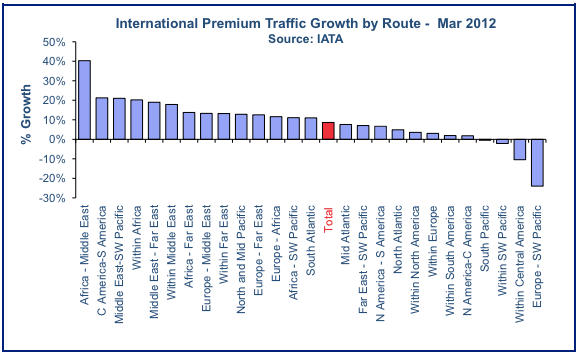
Neither airframe is captivating carriers. British Airways no longer views the market between Europe and Australia as core. At the end of Mar-2012 BA ended Bangkok-Sydney services, leaving only aSingapore-Sydney flight as part of a Europe-Australia network reduction conducted with joint service agreement partner Qantas. But even before the change, premium traffic was down considerably between the two continents. For all three months of 2012 that IATA has reported on premium traffic trends, Europe-Southwest Pacific has typically seen the sharpest declines by far: 16% in Jan-2012, 19% in Feb-2012 and 24% in Mar-2012. Without premium traffic prepared to pay an additional margin for the convenience of a non-stop, the route would struggle.

BA's pessimistic view comes with it already operating the 777, potentially making a 777 successor integration easier than at Qantas, which does not operate the 777. But even then the longest range version of the 777 successor, which could potentially operate the non-stop flights, would become a niche aircraft in BA's fleet, an undesirable position.

International premium traffic growth by route: Mar-2012
While the 777 successor would conceptually reach Sydney from Australia, an improved A380 would barely make it to Perth – and that of course is at the airframe manufacturer's best case calculation. Domestic connections from the far more populous eastern Australia would still be required and connections through Singapore, Qantas' main Asian hub, would still offer a shorter journey time. A potential service from Perth would come at the partial expense of the Singapore hub, which not only provides local traffic but also cargo. Qantas' planned premium carrier, postponed for the short term, would have provided feed for its long-haul services.
See related article: Qantas may say Malaysia Airlines negotiations are over, but many more chapters still to be written

It was on the back of network feed that Continental Airlines, now part of United Airlines, announced a 787 route to Auckland from its home hub atHouston. As CEO Jeff Smisek rhetorically asked, this ultra long-haul route was not about point-to-point traffic: "How many Kiwis live in Houston who want to fly to Auckland on a daily basis?" he asked. "Three?" United's network and that of Star Alliance, combined with the efficiency of the 787, made the route economically possible, Mr Smisek said.

...connecting traffic is limited at both ends...
Australia-Europe non-stop lacks an efficient aircraft like the 787 – Air New Zealand has referred to the 777-200LR as a "flying petrol tank" – and connecting traffic is limited at both ends. The Australian market is small, while in Europe, connections from London would require backtracking to continental Europe, reducing the time saved going non-stop to London compared to a one-stop through Asia or the Middle East. Further, following United's announcement in May-2012 to deploy its 787 between Tokyo and Denver, the new combination hinted that its proposed Houston-Auckland service no longer has its favoured position.

See related article: New Denver-Tokyo 787 service to help boost United's sagging trans-Pacific performance

QANTAS' EUROPEAN PRESENCE COMPARED TO EMIRATES, BUT THE TWO ARE ON DIFFERENT SCALES

Prior to BA and Qantas' Mar-2012 Australia-Europe restructure, Emirates typically operated approximately 22,000 one-way seats into London area airports compared to 12,000 from Qantas. Qantas' 12,000 seats were dependent on the markets of Australia and New Zealand as well as its three Asian transfer points: BangkokHong Kong and Singapore, a population pool of around 45 million.

For Emirates to fill its capacity into London, it has not only all of Qantas' markets but also additional points throughout North Asia, Southeast Asia, South Asia, the Middle East and Africa (the traffic also obviously fills other points besides London). India alone has a population of 1.3 billion, and while travel propensity there may be low, it does indicate that Qantas was simply over-exposed to Europe. To bemoan a smaller presence in Europe from Qantas than Emirates, as has been done in the public, is a non sequitur.

QANTAS WRONGLY CRITICISED FOR LACK OF 777

Emirates has also been praised for its prolific fleet of 777s, the lack of which in the Qantas fleet has been a contention with its pilot union. The reality is that, even if Qantas had 777s prior to its 2005 examination of the -200LR, the viability of the -200LR would have been far from certain.Virgin Australia around its launch (and prior to the strategy from a new management that favours virtual flying) evaluated the -200LR to supplement its -300ER but also ruled the aircraft out for non-stop services to Europe and New York.

Qantas has rightfully defended its position against its decision to order the 777. The 777 either has not offered sufficient payload or, when it did, Qantas had already committed to other fleet strategies. "By the time the first B777-300ER was delivered in [2004] with the payload range to match Qantas B744 operations, we were already committed to the A380s. A good decision, because the A380s have a 7 per cent unit cost advantage over the 777-300ER," Qantas CEO Alan Joyce remarked in Oct-2011. Additionally, when the first -300ER was delivered, its full capability was not realised by many airlines. Indeed, at the time of delivery the -300ER had orders for 77 frames; today the figure is over 600. Not even Emirates ordered the -300ER before the first delivery, and Cathay Pacific, another -300ER proponent, would not order its first example until Dec-2005.

...the 787 is the aircraft of the future...
At that time Qantas had planned its high capacity needs – it was expecting its first A380s shortly – and was evaluating its medium-gauge widebody needs, a role ideal for the 787. "It would have been a retrograde step at that point to revert to the 777s because by then they were already an older generation of technology, where the 787 is the aircraft of the future. It has a 25% trip cost advantage over the 777-300ER," Mr Joyce said.

When remarks have been made about how Qantas should have ordered the 777, what is actually implied is the aircraft's capability. And what is meant by comments that Qantas should have ordered the 777 is that Qantas needs an efficient medium/high capacity aircraft – yet that is exactly the role the 787 will fulfill, with the early -8 variant overlapping with the 777-200ER.

Qantas was a major purchaser of the 787 – with all the bargaining economics that would have delivered – but no-one expected such a lengthy delay in deliveries. The issue of the lack of the 777 has come to a head because those 787 delays have left a gap in Qantas' fleet, but a similar issue is replicated at airlines throughout the world. Few airlines sufficiently shielded themselves from 787 delays; exceptions are a handful of carriers that ordered 767s or refurbished older aircraft. It is an understandable outcome: each delay was incremental, pushing first delivery off but never enough in one delay announcement to warrant a significant change in strategy.

CHALLENGES AT QANTAS ARE NOT FLEET CHOICES OR DESTINATIONS – BUT A CHANGED WORLD

The world has changed around Qantas and the carrier, being at the end of the line, is increasingly challenged, as is its neighbour Air New Zealand. Destinations and aircraft types are not the silver bullet to reverse these developments; whatever city or aircraft you have, your competitor can have too. Qantas is unique, not just as an end of line carrier, but for its Jetstar LCC that has captured growth in a strong market and, internationally, helped feed passengers back into Qantas' traditional market.

Another solution is to work with who you can engage partners, now the cornerstone of Virgin Australia's international strategy. The latest development is commentary from Emirates that it would be open to partnering with Qantas, but this may become controversial as oneworld, led by IAG CEO Willie Walsh, sizes up one of Emirates' competitors – likely Qatar Airways – for a partnership.
...it will still be no silver bullet...
An Emirates relationship would be a hard nosed recognition of how the world has changed in the past few years but it will still be no silver bullet.
Meanwhile, the prospect of Europe-Australia non-stops seems destined to remain a conversation piece for pilot blogs rather than a medium-term reality.

*Link for This article compiled by Roger Smith from reliable sources CAPA - Aviation Analysis
*Speaking Image - Creation of DTN News ~ Defense Technology News 
*This article is being posted from Toronto, Canada By DTN News ~ Defense-Technology News Contact:dtnnews@ymail.com 
©COPYRIGHT (C) DTN NEWS DEFENSE-TECHNOLOGY NEWS
 

Thursday, November 17, 2011

DTN News - PICTURES OF TODAY: Pictures Of November 17, 2011

Asian Defense News: DTN News - PICTURES OF TODAY: Pictures Of November 17, 2011
(NSI News Source Info) TORONTO, Canada - November 17, 2011: View the latest pictures, photos and images events unfolding around the world of Today, prepared, compiled and presented By DTN News ~ Defense-Technology News.

Todays theme - November 17, 2011 - OBAMA IN AUSTRALIA, SYRIA UNREST plus others;


*Speaking Image - Creation of DTN News ~ Defense Technology News
*This article is being posted from Toronto, Canada By DTN News ~ Defense-Technology News

©

COPYRIGHT (C) DTN NEWS DEFENSE-TECHNOLOGY NEWS